Creators Are Now the Funnel
At Shoptalk, Travis Katz and Jessica Alba did not describe a new marketing channel. They described the end of the distinction between content and commerce.
Not blurring. Gone. What used to be a sequence, discovery then evaluation then purchase, now collapses into a single moment inside a piece of content. Consumers are not leaving video to shop. They are shopping inside it.
This is not a platform shift. It is a behavioral one. And the brands still treating creator partnerships as a media buy are missing what has actually changed.
Jessica Alba’s framing at Shoptalk Spring 2026 was direct: entertainment is no longer controlled by studios, networks, or a small group of decision makers. It is shaped by creators and audiences, which means influence has moved away from brand messaging and into the hands of individuals who have built credibility over time.
When consumers trust the person telling the story, they trust the products within it. That is a commercial fact, not a cultural observation.
Travis Katz outlined how YouTube now sits at the center of content consumption across every format and device: long-form video, Shorts, podcasts, living room television. It has surpassed traditional broadcast and cable in watch time. For brands, that means content is no longer confined to a campaign or placement. It exists across a system where discovery can happen at any moment.
That scale, combined with its format flexibility, makes it something closer to the roads than to any single vehicle on them.
___________________________________________________________________________________________
Every session at Shoptalk touched on some version of the same problem: customers are discovering products on TikTok, researching on Reddit, browsing on ChatGPT, comparing on Amazon, and converting in store. The journey is more fragmented than it has ever been, and the measurement tools most brands rely on were built for a simpler world.
Last-click attribution, still the default reporting model for many teams, systematically undervalues the channels that create demand in the first place. When a customer sees a brand on a YouTube creator’s video, discusses it in a Reddit thread, and then searches on Google two weeks later, last-click gives all the credit to that final search. The upper-funnel activity that actually built the intent gets zero recognition. Fospha’s data shows this undervaluation averages over 90% for awareness and consideration channels.
The result is a structural bias that quietly starves the channels responsible for growth. Brands end up over-investing in demand capture at the bottom of the funnel while under-investing in the demand creation that feeds it. The numbers tell the story: brands using Fospha’s full-funnel measurement achieve 30% higher ROAS than the market average. When Amazon halo effects are included, showing how paid social and video drive marketplace sales that siloed tools miss entirely, brands see an average 37% ROAS uplift.
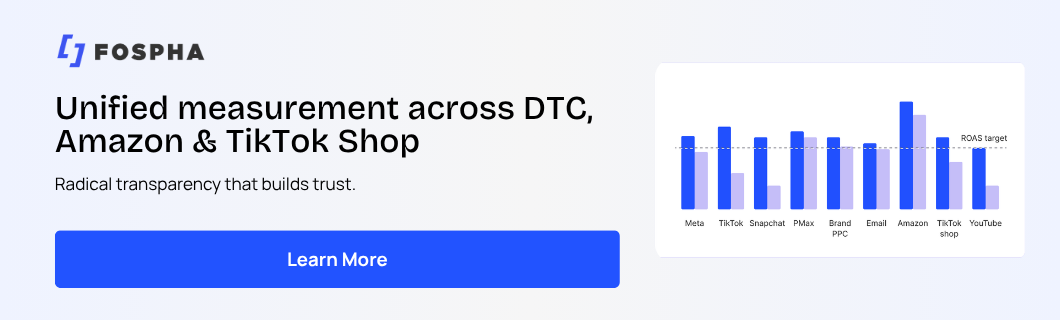
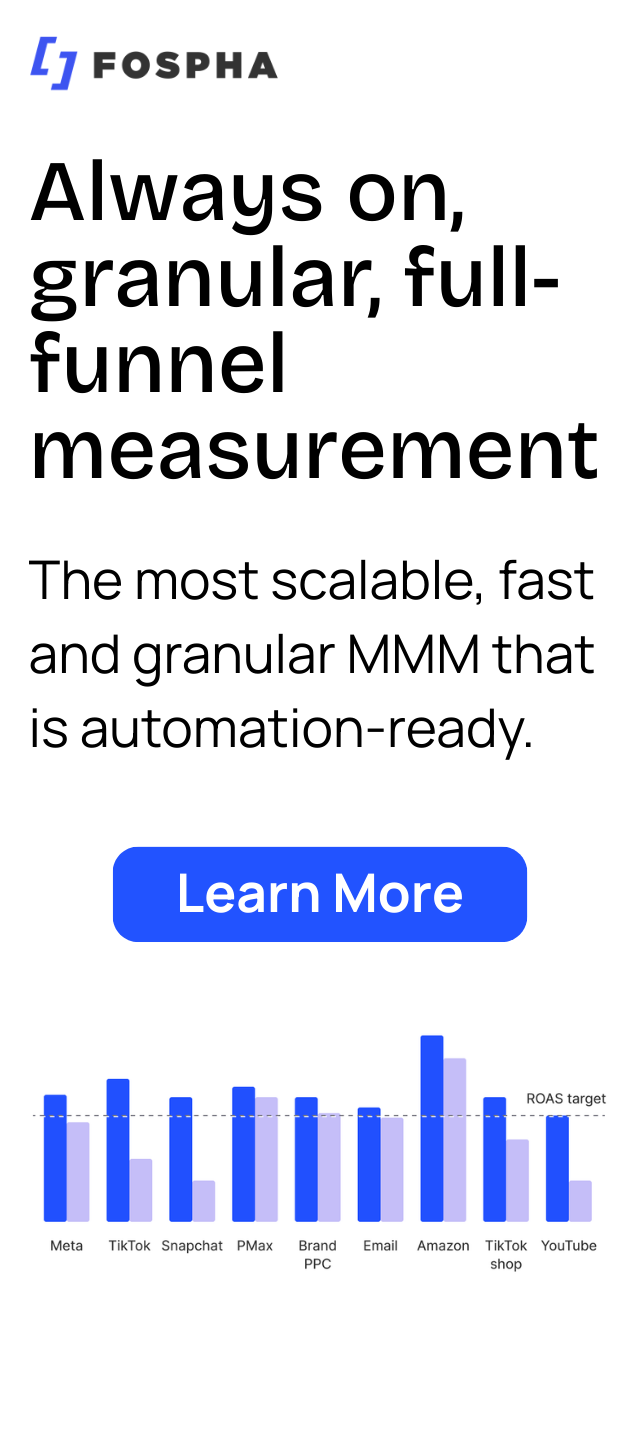
Fospha’s always-on Media Mix Model measures full-funnel impact across every channel, from DTC to Amazon to TikTok Shop and beyond, updated daily at the ad level. In a world where the customer journey looks like the one Shoptalk just spent three days describing, that kind of unified view is the difference between scaling with confidence and scaling on assumption.
Learn more at fospha.com
YouTube audiences are consuming over 100 million hours of shopping-related content every single day. That figure deserves a moment to land. This is not an emerging behavior. It is an established one, and it is where product decisions are being made.
If a brand is not present in creator ecosystems, it is not present in the decision-making process. That is the correct and uncomfortable way to state it.
The creator is both the point of inspiration and the point of conversion. The traditional funnel does not just shorten. It disappears.
Jessica Alba built The Honest Company before she launched a single product, by building a community and sharing real experiences that audiences could relate to. That foundation is what made the commercial layer credible when it arrived.
The same principle extends to creator partnerships. Minimal guidance, genuine alignment, and long-term relationships consistently outperform structured, one-off campaigns. The more tightly a brand tries to control a creator’s voice, the less the audience believes what they hear.
Authenticity is not a content style. It is the absence of visible control.
AI is reducing the friction that once made creator partnerships difficult to scale: identifying the right creators, matching content to the right audiences, amplifying high-performing content more efficiently. Early data suggests creator-led content paired with AI-driven distribution significantly outperforms traditional creative.
But the fundamentals have not shifted. Strong creator relationships and authentic storytelling sit at the core. AI enhances the ability to execute against them. It does not replace the need to get them right.
The distinction between content and marketing will continue to blur. Brands are increasingly positioned to fund and produce entertainment directly, creating deeper storytelling, stronger creator relationships, and more integrated commerce experiences without layers of intermediaries in between.
In this model, content is not a channel. It becomes the product. The brands that recognize this early will not just appear in culture. They will shape it.
Leave a Reply
You must be logged in to post a comment.